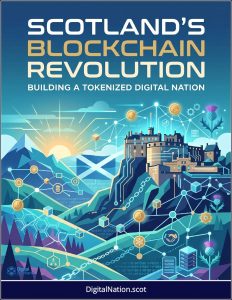
 The passage of the Digital Assets (Scotland) Act 2026 marks a pivotal, if modest, milestone in Scotland’s journey into the digital age.
As Professor Bill Buchanan OBE FRSE and colleagues at the Scottish Centre of Excellence in Digital Trust and DLT (TRUST) have powerfully argued, it provides essential legal clarity by recognizing digital assets as a distinct form of property under Scots law.
Yet this is merely the opening chapter. The true opportunity lies in harnessing blockchain, distributed ledger technology (DLT), tokenization, and cryptographic trust to build a dynamic, innovative, and globally competitive digital economy.
This book explores that bold vision. It moves beyond narrow legal reform to examine how Scotland can lead in a tokenized world—where assets, identities, and transactions exist seamlessly on secure, verifiable digital rails. At its heart is the conviction that technology, underpinned by world-class research and pragmatic governance, can drive prosperity, enhance trust, and position Scotland as an ethical digital nation on the global stage.
The Tokenized Economy: Beyond Bits and Bytes
Tokenization—the representation of real-world assets (RWAs) as digital tokens on blockchain—promises to reshape finance, ownership, and commerce. Illiquid assets like real estate, fine art, whisky casks, renewable energy projects, or intellectual property can be fractionalized, traded 24/7 with near-instant settlement, and accessed by a broader range of investors. Global projections suggest the tokenized asset market could reach trillions in value, unlocking liquidity, reducing intermediaries, and democratizing investment.
For Scotland, the potential is profound. Imagine tokenized shares in Highland estates or renewable wind farms enabling community investment and green finance. Scottish fintech firms could pioneer secure digital identity solutions, privacy-enhancing technologies, and efficient cross-border trade finance for SMEs. Supply chains for food, drink, and manufacturing gain transparency and provenance tracking—vital for premium exports like Scotch whisky. Public services could leverage DLT for secure data sharing, citizen-owned health records, or streamlined benefits, always with privacy and security at the core.
Professor Buchanan’s emphasis on cryptographic keys as the true locus of ownership, alongside clear distinctions between permissioned and permissionless systems, highlights the need for technically informed frameworks. These innovations demand more than recognition of property rights; they require robust digital signatures, custody rules, interoperability standards, and a skilled workforce.
Scotland’s Unique Strengths
Scotland enters this era with formidable advantages:
- Academic and Research Excellence: Institutions like Edinburgh Napier University (home to TRUST), the University of Edinburgh’s Blockchain Technology Laboratory, and the University of Glasgow’s Trustworthy Connected Systems Lab form a powerful innovation triangle. Initiatives like the Blockpass ID Lab have long advanced citizen-centric digital identity and cryptography.
- Fintech and Financial Heritage: Edinburgh’s status as a global financial center, combined with FinTech Scotland’s ecosystem, provides deep expertise in banking, insurance, and investment. The new Centre of Excellence channels this into practical innovation challenges around digital payments, assets, and trust.
- Legal Innovation: Scots law’s flexibility, now updated via the 2026 Act, can evolve into a competitive advantage—offering certainty while encouraging experimentation, much like progressive regimes in Singapore, Switzerland, or Liechtenstein.
- Ethical and Inclusive Vision: Scotland’s commitment to an ethical digital nation—emphasizing inclusion, privacy, and public good—differentiates it in a world wary of unchecked tech power.
Building the Digital Nation
Realizing this potential requires concerted action across policy, industry, academia, and civil society. Key pillars include:
- Forward-Looking Regulation: Building on the Act with detailed guidance on tokenization, security tokens, DeFi integration, and cross-border recognition.
- Innovation Infrastructure: Expanding sandboxes, demonstration environments, and public-private challenges through TRUST and partners.
- Skills and Talent: Investing in education—from school-level digital literacy to advanced cryptography and blockchain programs—to retain and attract global talent.
- Sectoral Leadership: Targeting high-impact areas such as green finance, health tech, cultural heritage tokenization, and SME trade finance.
- International Positioning: Marketing Scotland as a trusted hub for digital assets, leveraging its reputation for integrity, innovation, and collaboration.
Challenges remain: technical complexity, cybersecurity risks, talent competition, and the need for balanced regulation that protects without stifling. Yet history shows that nations embracing technological shifts—rather than resisting them—thrive. Scotland has the pedigree, from the Enlightenment to the Industrial Revolution and now the Digital one.
A Call to Action
This book gathers insights from technologists like Professor Buchanan, legal experts, policymakers, entrepreneurs, and visionaries. It charts pathways for tokenization in practice, the future of digital trust, governance models, economic impacts, and case studies from Scotland and beyond.
Scotland stands at a crossroads. With the foundational legal step now taken, we can choose incrementalism—or we can seize the moment to build a tokenized, trustworthy, and prosperous digital nation that punches above its weight globally. The technology exists. The talent is here. The moment is now.
The chapters ahead outline how we get there. Welcome to Scotland’s tokenized future.