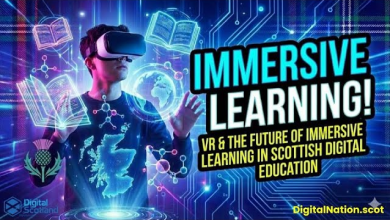
The University of Glasgow stands at the forefront of virtual reality (VR), augmented reality (AR), and extended reality (XR) innovation in Scotland, particularly in education, cultural heritage, and perceptual philosophy.
Through dedicated facilities and major projects, the institution is transforming how people access and interact with knowledge and history.
Central to this effort is the Advanced Research Centre’s ARC-XR hub, a state-of-the-art studio supporting interdisciplinary work in immersive technologies.
It hosts diverse projects, including XRed (XR in education), EliXR, Deepsea Nexus, ViAjeRo (passenger experiences), motion sickness mitigation, and studies on aphantasia and memory. Earlier initiatives explored AR ethics, perception, and metaphysics, funded by the Royal Society of Edinburgh (2021–2023).
In education, XR revolutionizes teaching and learning. A £5 million partnership with EON Reality created the UofG EON-XR Centre, delivering AI-enhanced immersive tools for subjects like chemistry, archaeology, and engineering.
Collaborations with Meta (2023–2024) produced white papers highlighting XR’s “transformational power,” boosting student engagement, confidence, and retention while addressing access and integration barriers. The Edify project (with Sublime Digital, Innovate UK-funded) uses VR and gaming tech to simplify complex concepts and analyze learning in immersive settings. Related efforts like Project Mobius examine motion illusions without inducing sickness.
Museums in the Metaverse
The flagship initiative for cultural heritage is the Museums in the Metaverse (MiM) project, a £6.2 million endeavor launched in late 2023 via the UK Government’s Innovation Accelerator programme (administered by Innovate UK on behalf of UK Research and Innovation).
Led by Professor Neil McDonnell (Professor of Philosophy & Extended Reality Technology), alongside Dr Pauline Mackay, Professor Murray Pittock, Professor Maria Economou, and Dr Lynn Verschuren, MiM tackles a core issue: only about 10% of museum collections are displayed due to space, preservation, geography, cost, mobility, and operating hours. Examples include the Hunterian Museum’s 1.4 million objects and the British Museum’s 8 million.
MiM develops a two-sided XR Cultural Heritage platform. For the public, it offers immersive exploration of digitized assets—virtual environments, interactive 3D models, close-up object examination, and personal curation of digital collections. For GLAM institutions (galleries, libraries, archives, museums), it provides tools to create, upload, and manage high-fidelity 3D content and exhibitions. This shifts experiences from passive viewing to active, inclusive engagement.
By March 2026, key milestones include six completed virtual environments, such as a Victorian laboratory inspired by the university’s Gilbert Scott Building and Lord Kelvin-themed metaverse exhibitions.
Notable digitizations feature Dolly the Sheep’s skull, Mary Queen of Scots’ death mask, a Goliath beetle, and walrus skulls. A 2024 global survey (over 2,000 respondents) confirmed strong demand for XR access and awareness of hidden collections.
Realities & Immersion Glasgow
The project established Realities & Immersion Glasgow (RIG) as an immersive heritage research hub and collaborated on VR pop-ups with the National Portrait Gallery in early 2026.
A major public-facing innovation is the [un]box Virtual Reality kiosk, unveiled in December 2025 at Glasgow Science Centre for trials (with wider rollout planned). This self-contained installation lets visitors don headsets to enter virtual worlds, “hold” or orbit 3D artifacts, and bridge physical and digital realms.
Rooted in the university’s VR/AR Lab (established 2016 in the Centre for the Study of Perceptual Experience), philosophical research continues to examine reality in virtual spaces, ethics, perception, and practical issues like motion sickness reduction.
Overall, these efforts position Glasgow and Scotland as leaders in ethical, evidence-based XR adoption. Benefits include democratized access for remote, disabled, or mobility-limited audiences; enhanced education through immersive Scottish heritage lessons; and economic gains via tourism and the creative sector.
MiM aims to scale into an open platform enabling global museum participation and user-created “dream museums,” where cultural heritage transcends physical walls, becoming accessible through digital portals.