A Technology Blueprint for Scotland’s Digital Passport: Pioneering Digital Sovereignty in an Independent Nation
This blueprint presents a pragmatic, future-proof architecture that carefully balances international interoperability, citizen privacy, national security, and economic opportunity, positioning an independent Scotland as a European leader in sovereign digital identity.

 An independent Scotland would inherit a strong foundation in digital public services, including platforms such as MyGovScotland and NHS Scotland’s digital health records, along with a commitment to data ethics.
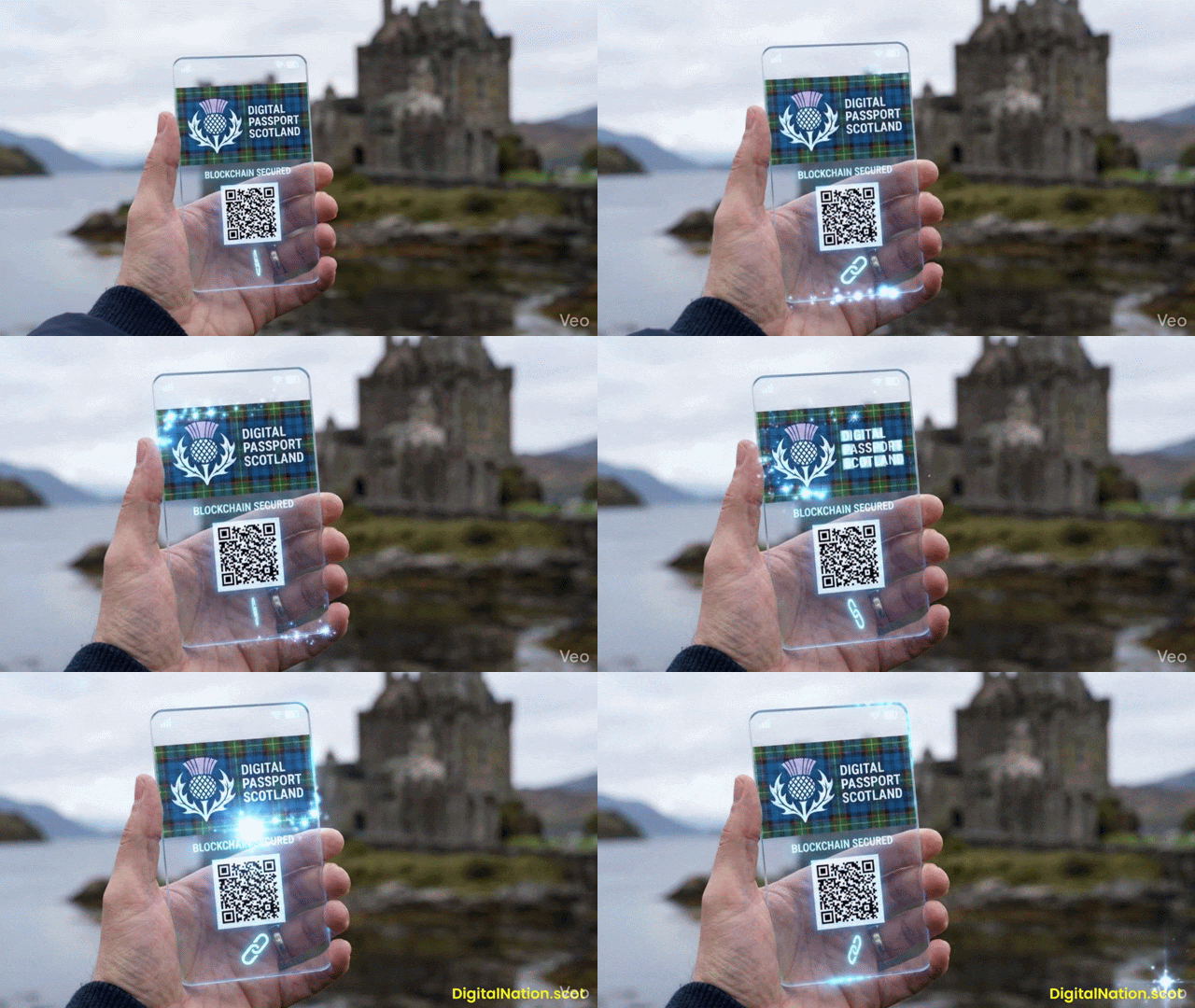
A flagship Digital Passport, built on the International Civil Aviation Organization’s Digital Travel Credential framework, would serve as both a secure travel document fully compliant with global standards and the cornerstone of a broader Scottish Digital Identity Ecosystem.
This blueprint presents a pragmatic, future-proof architecture that carefully balances international interoperability, citizen privacy, national security, and economic opportunity. It would position an independent Scotland as a European leader in sovereign digital identity, potentially accelerating progress toward EU accession or EFTA alignment while ensuring complete control over its citizens’ data.
Strategic Objectives
The strategic objectives for Scotland’s Digital Passport are clear and ambitious. The system must achieve full global recognition through compliance with ICAO Doc 9303 standards for electronic Machine Readable Travel Documents and the emerging Digital Travel Credential specifications.
It should enable seamless travel and everyday use, allowing touchless border processing, airline check-ins, hotel registrations, and access to domestic services such as banking, voting, and driving licences through a single mobile credential. Data sovereignty and privacy remain central, with citizens retaining control over their information and minimal disclosure required for non-travel scenarios, while avoiding any central repository that could become a target for breaches.
The design must also prioritize resilience and inclusivity, incorporating offline functionality, quantum-ready cryptography, and accessibility features for all demographics. Economically, the passport would reduce border friction, with pilots demonstrating significant reductions in processing times, thereby boosting tourism and attracting investment in fintech and identity technologies.
Core Technical Standards
At its core, the Digital Passport anchors on ICAO’s Digital Travel Credential model. This includes a Virtual Component, which is a cryptographically signed digital dataset that mirrors the Machine Readable Zone data along with facial biometrics, and a Physical Component residing on the citizen’s smartphone or a secure hardware token. Three progressive types of credentials support a phased rollout.
Type 1 credentials, suitable for immediate implementation, would be derived from an existing physical passport through self-service methods such as NFC chip scanning or secure app upload. Types 2 and 3, representing the longer-term vision, enable native issuance directly to the citizen’s digital wallet, potentially reducing reliance on physical booklets as international agreements evolve.
Complementary standards enhance flexibility and future compatibility. These include W3C Verifiable Credentials and Decentralized Identifiers for selective disclosure in non-travel contexts, such as proving age or residency without revealing full passport details.
Alignment with the EU’s eIDAS 2.0 and the European Digital Identity Wallet framework would allow seamless integration if Scotland pursues closer European ties. Biometric standards follow ISO/IEC guidelines for facial recognition and liveness detection, while cryptography employs robust algorithms including ECDSA or EdDSA for signatures, post-quantum options like Dilithium and Kyber for long-term security, and AES-256 for encryption.
A sovereign Public Key Infrastructure, complete with Scotland’s own Country Signing Certification Authority and Document Signer Certificates, would integrate with ICAO’s Public Key Directory to ensure global trust.
System Architecture
The high-level system architecture adopts a hybrid sovereign-decentralized model that keeps sensitive data under national control while empowering citizens. In the issuance layer, managed by a Scottish Passport Authority, enrolment would occur through secure centres or remote online processes backed by in-person biometric verification for initial applications.
Certified devices would capture facial biometrics, with optional fingerprint or iris data, before generating the signed Digital Travel Credential Virtual Component.
This credential would be securely bound to the citizen’s device. Revocation information would be published through a tamper-proof mechanism, such as a permissioned distributed ledger or traditional certificate revocation lists anchored to blockchain for enhanced auditability. Citizens would interact with the system primarily through a mobile-first wallet application called ScotPass, built on the secure enclaves of iOS and Android devices.
The app would support biometric unlocking with fallback PIN protection, store the encrypted credential, and allow offline presentation via QR code or NFC. For broader use, the wallet could integrate with a full European Digital Identity Wallet to handle additional credentials such as driving licences or health records. Verification processes would vary by context. At borders and with airlines, NFC taps or QR scans would enable facial biometric matching directly against the credential.
Pre-arrival screening could use privacy-preserving, time-limited tokens. Domestic verifiers, including banks and retailers, would receive only the specific attributes needed through selective disclosure mechanisms, with cryptographic proofs ensuring validity without unnecessary data exposure.
All backend infrastructure would reside in sovereign or trusted clouds with strict data residency requirements, minimizing data flows so that the citizen’s device holds the authoritative credential and verifiers never receive raw biometrics except where strictly required for matching.
Key Innovations
Several key innovations would distinguish Scotland’s Digital Passport and reflect national values. Privacy by design would be embedded through zero-knowledge proofs and attribute-based encryption, enabling citizens to generate targeted attestations such as age verification or residency confirmation without exposing sensitive details.
Offline-first capabilities would ensure full validation even without internet connectivity by relying on cryptographic signatures and embedded revocation data.
An interoperability hub could position Scotland as a regional service provider for smaller nations or partners sharing cultural ties, turning the technology into an exportable asset. Sustainability goals would be supported by reducing reliance on physical documents and utilizing energy-efficient cloud hosting aligned with Scotland’s net-zero ambitions.
Accessibility features, including voice-guided enrolment and support for varied devices, would ensure no citizen is left behind.
Security and Trust Framework
Security and trust form the foundation of the entire system. The threat model addresses risks ranging from credential cloning and relay attacks to advanced quantum cryptanalysis and state-sponsored threats. Protections include hardware-backed keys, remote device wipe functions, real-time anomaly detection during issuance, and ongoing penetration testing.
An independent oversight board, incorporating civil society representatives, would publish annual audits of cryptographic implementations and privacy practices. Robust incident response protocols, featuring rapid revocation and blockchain-anchored logs, would maintain public confidence.
Implementation Roadmap
Implementation could follow a structured five-year roadmap. In the first two years, foundational work would include legislation recognizing digital passport equivalence, issuance of Type 1 credentials alongside physical passports, and pilot programs with cooperative nations and major airlines.
The ScotPass application and enrolment infrastructure would be developed during this phase. Years two through four would focus on scaling with native Type 2 and 3 issuance, deeper European Digital Identity Wallet integration if politically appropriate, and expansion into domestic services across banking, transport, and government.
Full participation in international directories and bilateral agreements would solidify global acceptance. By the fifth year and beyond, the physical passport could become optional for many travellers, with Scotland exporting its technology and standards as a distinctive national innovation.
Challenges and Mitigations
Potential challenges require proactive mitigation. International recognition would be secured through strict adherence to ICAO standards and sustained diplomatic engagement. The digital divide could be addressed by providing free devices or support for vulnerable groups, maintaining robust offline modes, and retaining physical alternatives.
Cybersecurity risks would be managed via continuous red-teaming and sovereign key management practices. Privacy and political concerns could be alleviated by making the digital version fully opt-in and establishing transparent governance structures that learn from past controversies in other nations. Vendor lock-in would be avoided by favoring open-source reference implementations and engaging multiple certified suppliers.
Conclusion
Scotland’s Digital Passport represents far more than a modern travel document. It stands as a powerful assertion of independence in the digital era.
By leveraging ICAO Digital Travel Credential standards, embracing verifiable credentials technology, and aligning thoughtfully with European digital identity principles, an independent Scotland can deliver a system that is simultaneously secure, privacy-respecting, convenient, and fully interoperable on the world stage.
Citizens would benefit from effortless travel and streamlined access to public and private services, while the nation would gain sovereign control over its identity infrastructure and a platform for technological and economic innovation.
In a time when digital borders are rapidly evolving, Scotland has a unique opportunity to lead by example. With the necessary technology already available, the combination of political vision and meticulous execution could establish the country as a digital pioneer—potentially becoming the Estonia of the 2030s, a small nation wielding significant influence through forward-thinking identity systems.