Exploring the Potential for Augmented and Metaverse Virtual Reality Adoption in Scottish Tourism
The potential for AR and Metaverse VR in Scottish tourism is immense, offering ways to innovate while preserving heritage.

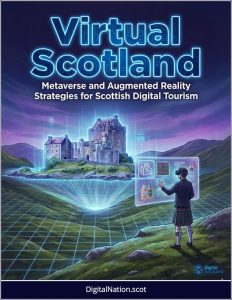 Scotland’s tourism industry, valued at around £11 billion annually, thrives on its rich heritage, stunning landscapes, and iconic landmarks like Edinburgh Castle, Loch Ness, and the Highlands.
In this modern digital era technologies such as Augmented Reality (AR), Virtual Reality (VR), and the emerging Metaverse offer new avenues to enhance visitor experiences, expand reach, and drive economic growth.
AR overlays digital information onto the real world, while VR immerses users in fully simulated environments.
The Metaverse combines these with blockchain and social elements to create persistent virtual worlds. This market research article examines the global trends, current adoption, benefits, challenges, and future potential for these technologies in Scottish tourism, drawing on recent data and examples.
Global Market Overview
The integration of AR, VR, and Metaverse technologies into tourism is accelerating, fueled by post-COVID demand for contactless and virtual experiences. The global Metaverse market was estimated at USD 105.40 billion in 2024 and is projected to reach USD 936.57 billion by 2030, growing at a CAGR of 46.4%. Within this, tourism and hospitality sectors are leveraging virtual tours and immersive previews to boost engagement. For instance, platforms like Eventcombo allow users to explore landmarks such as Dubai’s Burj Khalifa virtually.
The broader AR and VR market generated USD 59.76 billion in 2024, expected to hit USD 200.87 billion by 2030 at a CAGR of 22%. AR is poised for faster growth at 26% CAGR, driven by applications in gaming, education, and tourism. Virtual tourism alone was valued at USD 10.34 billion in 2024 and is forecasted to reach USD 111.16 billion by 2033, with a CAGR of 30.2%. Key drivers include immersive technologies for cultural preservation, education, and inclusive travel, with Asia-Pacific showing strong regional growth.
In the Metaverse context, tourism adoption is rising, with virtual replicas of destinations enabling “test-drive” visits. Projections for the global Metaverse tourism market suggest explosive growth, potentially exceeding USD 155 billion between 2023-2028 at a 27% CAGR, positioning early adopters like Scotland for significant gains.
Current Adoption in Tourism and Scotland’s Landscape
Globally, AR and VR are transforming tourism by offering interactive experiences. Museums use VR for virtual exhibits, while AR apps enhance on-site visits with historical overlays. In Scotland, adoption is gaining momentum, blending digital innovation with its unique cultural assets.
One early example is the VisitScotland VR app, launched in 2017, which uses 360° imagery to let users explore a virtual glen complete with Highland cows and interactive elements. More recently, the National Trust for Scotland partnered with Reydar for an AR campaign at Brodie Castle, where visitors animate a 3D rabbit character via their devices, encouraging social media sharing and family engagement.
Stirling became the world’s first fully AR-enabled city in 2022 through a collaboration with BT and Historic Environment Scotland, allowing visitors to access digital overlays of historical sites via an app. At Urquhart Castle, the “Historiscope” – AR binoculars developed by SENSEcity – lets users view medieval reconstructions of the site, merging archaeology with immersive storytelling. A 360° VR tour of Urquhart Castle further immerses users in its history along Loch Ness.
Metaverse initiatives are emerging too. The “Museums in the Metaverse” project, a £5.6 million UK-funded effort led by the University of Glasgow with partners like Historic Environment Scotland and National Museums Scotland, digitizes thousands of artifacts for virtual access. Launched in 2023, it aims to boost education, tourism, and creative economies by creating XR platforms. In 2023, the Great Tapestry of Scotland was replicated in the Metaverse by New Frontier, offering interactive NFTs for themes like battles and traditions, serving as a toolkit for tourism and education. The “Metinburgh” concept envisions a photorealistic digital twin of Edinburgh, starting with Castlehill, to redefine tourism through VR/AR and blockchain.
Recent discussions on X highlight enthusiasm, with concepts like AI-powered AR tours in Ghent inspiring similar ideas for Scottish cities, and calls for “Virtual Scotland” to attract global visitors.
Benefits for Scottish Tourism
Adopting AR and Metaverse VR could revolutionize Scottish tourism by:
- Enhancing Accessibility and Inclusivity: Virtual tours make remote or inaccessible sites like the Highlands available to global audiences, including those with mobility issues. This aligns with rising demand for inclusive experiences.
- Boosting Engagement and Revenue: Immersive previews can convert virtual visitors into physical ones, increasing bookings. AR gamification, like animated characters at castles, encourages repeat visits and social sharing.
- Cultural Preservation and Education: Technologies preserve heritage digitally, as seen in the Great Tapestry Metaverse, while educating users interactively.
- Economic Impact: With tourism contributing £11 billion yearly, virtual elements could tap into the Metaverse’s projected $486 billion market by 2030, creating new income streams like NFTs and virtual events.
Challenges and Barriers
Despite potential, challenges include:
- Technological and Infrastructure Hurdles: High costs for development and hardware (e.g., VR headsets) may limit adoption. Network limitations in rural Scotland could hinder seamless experiences.
- User Adoption: Financial and psychological barriers, such as effort to engage with Metaverse platforms, may deter users, especially older demographics.
- Content Quality and Authenticity: Ensuring digital replicas maintain cultural integrity is crucial to avoid diluting real-world visits.
- Competition and ROI: While global growth is strong, Scotland must compete with tech-savvy destinations like Dubai.
Future Outlook and Recommendations
By 2030, AR/VR adoption in tourism could see Scotland capturing a share of the $200+ billion market through expanded virtual offerings. Concepts like “Virtual Scotland” – integrating AR along routes like the North Coast 500 – could attract millions of “test-drive” visitors. Recommendations include government funding for pilots, partnerships with tech firms like Meta, and training for tourism operators. Prioritizing user-friendly apps and hybrid experiences (virtual previews leading to physical visits) will maximize impact.
The potential for AR and Metaverse VR in Scottish tourism is immense, offering ways to innovate while preserving heritage. With growing markets and successful pilots, Scotland can position itself as a digital tourism leader, blending its timeless appeal with cutting-edge technology to attract a global audience.