Scotland’s Opportunity to Tap into the Explosive Market for Quantum Computing
The quantum revolution is accelerating. The market opportunity is not just large—it is foundational to the next era of computing.

 As DIGIT reports Quantcore, a University of Glasgow spin-out, has raised £2.5m in seed funding to create a sovereign supply chain for quantum hardware, as the UK races to build domestic capacity in technologies critical to national security and economic competitiveness.
Quantum computing stands at the threshold of transforming industries by solving problems that classical computers cannot handle efficiently—or at all.
Leveraging the principles of quantum mechanics, such as superposition and entanglement, these systems use qubits instead of bits to perform complex calculations at unprecedented speeds.
The technology is shifting from laboratory experiments to early commercial pilots, creating a massive market opportunity. Analysts project explosive growth driven by breakthroughs in hardware, cloud accessibility, and urgent demand for quantum advantage in high-stakes sectors.
Current Market Size and Projections
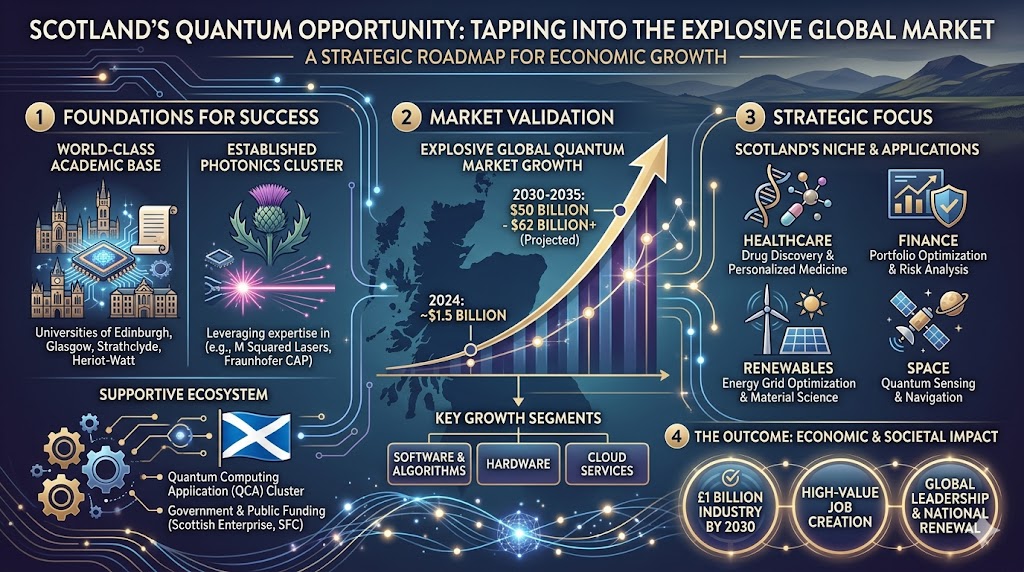
The global quantum computing market is still in its early stages but growing rapidly. Estimates for 2025 place the market size between approximately $1.4 billion and $3.5 billion, depending on the source. Projections show strong momentum:
- By 2030, the market could reach $4–20 billion, with CAGRs ranging from 20% to over 40%.
- Longer-term forecasts to 2035 point to values as high as $19–27 billion.
One analysis from The Quantum Insider estimates that quantum computing could generate a cumulative $1 trillion in economic value creation for end users between 2025 and 2035, far exceeding direct hardware and service revenues (projected at around $50 billion cumulatively).
North America currently dominates with roughly 40–60% market share, fueled by heavy private-sector investment and government initiatives like the U.S. National Quantum Initiative. Cloud-based deployment models are accelerating adoption by lowering barriers, allowing companies to access quantum resources via platforms from AWS, Microsoft Azure, and IBM without massive upfront infrastructure costs.
Key Applications Driving Demand
The real market opportunity lies in quantum’s ability to tackle intractable problems across industries. Early use cases are already emerging in 2026, with hybrid quantum-classical systems delivering value today:
- Pharmaceuticals and Healthcare: Quantum simulation excels at modeling molecular interactions, accelerating drug discovery, protein folding, and materials design for new therapies. This could slash R&D timelines and costs dramatically.
- Finance and Risk Management: Portfolio optimization, option pricing, fraud detection, and complex risk modeling benefit from quantum algorithms that outperform classical methods on combinatorial problems.
- Logistics and Supply Chain: Optimization of routing, scheduling, and resource allocation offers efficiency gains in transportation, manufacturing, and global trade.
- Energy, Materials, and Climate: Quantum computers simulate chemical reactions for next-generation batteries, catalysts, and carbon-capture technologies, supporting the clean-energy transition.
- Defense and Aerospace: Applications include secure communications, advanced sensing, mission planning, and cryptography—both as a defensive tool and a potential threat to current encryption standards.
These sectors represent enormous total addressable markets (TAMs), with quantum providing “quantum advantage” in simulation, optimization, and machine learning subfields.
Major Players and the Competitive Landscape
The ecosystem blends established tech giants with agile startups:
- IBM, Google (Alphabet), Microsoft, and Amazon lead in hardware roadmaps, software stacks, and cloud quantum services. IBM, for instance, continues aggressive scaling toward fault-tolerant systems.
- Pure-play leaders like IonQ (trapped-ion technology), Rigetti Computing (superconducting), D-Wave (quantum annealing), PsiQuantum (photonic), and QuEra are commercializing systems and securing major enterprise/government contracts. IonQ and others have raised billions in recent funding rounds, signaling strong investor confidence.
Hundreds of companies now populate the supply chain—from qubit hardware and error-correction software to full-stack platforms—creating a vibrant innovation ecosystem.
Challenges and Barriers to Adoption
Despite the hype, significant hurdles remain. Qubits are fragile and prone to errors from noise, decoherence, and environmental interference, requiring advanced error correction and millions of physical qubits for truly fault-tolerant machines. Scalability, cryogenic infrastructure costs, and a talent shortage (with demand outstripping supply) are real constraints. Integration with existing classical systems and organizational resistance also slow enterprise uptake.
Regulatory frameworks for quantum-safe cryptography and international competition (particularly with heavy investments from China and Europe) add layers of complexity. However, hybrid approaches and cloud access are mitigating many of these issues in the near term.
Investment and Government Momentum
Public and private funding is pouring in—governments worldwide have committed tens of billions, while venture capital and corporate R&D continue to flow. This support is not just about hardware; it extends to workforce development, standards, and commercialization pathways. The result is a virtuous cycle: more funding accelerates technical milestones, which in turn attract more investment and talent.
The Road Ahead: A Trillion-Dollar Horizon
By the early 2030s, experts anticipate “quantum advantage” in practical applications, followed by broader commercialization in the 2035+ timeframe. The market opportunity is not just about selling quantum computers—it encompasses software, services, consulting, quantum-safe security, and entirely new business models built on quantum insights.
For investors, enterprises, and policymakers, the message is clear: quantum computing is no longer a distant sci-fi concept. It is an emerging strategic asset with the potential to reshape global competitiveness in finance, health, energy, and defense. Organizations that begin building quantum readiness now—through pilots, talent acquisition, and partnerships—will be best positioned to capture value in what could become one of the most transformative technologies of the 21st century.
The quantum revolution is accelerating. The market opportunity is not just large—it is foundational to the next era of computing.