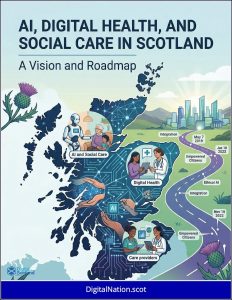
AI, Digital Health, and Social Care in Scotland – A Vision and Roadmap
Using AI and digital technologies to deliver proactive, personalised, holistic care, integrating NHS, social services, and housing data to reduce inequalities, support ageing populations, and enable independent living across urban and rural areas.

 Scotland stands at a transformative crossroads.
In a nation defined by its rugged landscapes, tight-knit communities, and commitment to universal care through the NHS and integrated health and social care partnerships, technology offers the chance to reimagine “care” itself.
No longer confined to hospital beds or GP surgeries, care becomes a simple, all-encompassing concept: support for the whole person across the entire span of life.
It spans traditional medical healthcare—diagnosing illness, managing chronic conditions, and delivering acute treatment—while embracing social determinants such as homelessness, elderly isolation, mental wellbeing, family pressures, and community disconnection.
An inclusive approach means that a young person sleeping rough in Glasgow, an older adult living alone in the Outer Hebrides, a family carer in Dundee juggling work and dementia support, and a patient recovering from surgery in Aberdeen all receive seamless, proactive, personalised help.
|
 Download the
 This is not science fiction. It builds directly on Scotland’s existing foundations: the refreshed Digital Health and Care Strategy (2021), with its 2025–2026 Delivery Plan Care in the Digital Age, the newly launched Scotland’s AI Strategy 2026–2031, and the Data Strategy for Health and Social Care. The central theme is unity—digital tools and AI do not replace human connection; they amplify it, removing barriers of geography, time, and resource scarcity so that “care” truly reaches everyone, everywhere.
Scotland’s Context: Pressures and Opportunities
Scotland faces well-documented challenges. An ageing population strains social care services. Rural and island communities grapple with distance and workforce shortages.
Health inequalities persist, with higher rates of loneliness and isolation reported in deprived areas, among disabled people, lone parents, and those over 75. Homelessness remains a visible crisis, often intertwined with mental health, substance use, and physical conditions. Post-pandemic recovery, cost-of-living pressures, and the ongoing shift toward community-based care have exposed the limits of fragmented systems.
Yet Scotland also possesses unique strengths: world-class universities and AI research hubs in Edinburgh and Glasgow, a strong tradition of data collaboration across NHS boards, local authorities, and the third sector, and recent accelerations in digital adoption (Near Me video consultations, remote monitoring via Connect Me, digital telecare for 142,000 users, and AI pilots such as SPARRAv4 for predicting emergency admissions or NeurEYE for early dementia detection from retinal scans).
The opportunity is clear: use AI and digital technologies not as add-ons but as the connective tissue that makes holistic care possible.
Redefining Care: Holistic, Proactive, and Inclusive
At the heart of this vision is a single, powerful idea: care is everything that helps a person live well. Medical records sit alongside housing status, social connection data (with explicit consent and robust privacy), environmental factors, and personal goals.
AI does not judge or stigmatise; it identifies patterns early—flagging rising risk of isolation before an elderly neighbour stops answering calls, or linking a rough sleeper’s health data with housing services to prevent winter hospital admissions.
This inclusive model rejects silos. A person experiencing homelessness receives not just emergency shelter but AI-supported personalised plans that integrate addiction support, job training, mental health apps, and primary care follow-up.
An isolated pensioner gets a digital companion that detects changes in mobility or mood and automatically alerts a blended team of human carers, family (if chosen), and community volunteers. Chronic disease management expands to include social prescribing—AI recommending local walking groups or befriending services alongside medication reminders.
The Digital Health and Care Strategy’s vision captures this perfectly: “To improve the care and wellbeing of people in Scotland by making best use of digital technologies in the design and delivery of services… providing whole of life support; active, independent living; and care that is proactive and personalised.” AI and digital tools make this real at scale.
The Transformative Power of AI and Digital Health
AI excels at what humans cannot do alone: analysing vast, linked datasets in real time while protecting privacy through federated learning and secure clouds. Key applications include:
- Predictive and preventive care: Tools like enhanced SPARRA predict not only hospital admissions but also social crises—housing instability or loneliness spikes—triggering integrated interventions across health boards and local authorities.
- Personalised support: Wearables, smart home sensors, and voice-activated AI companions enable older people to age in place safely while combating isolation through virtual social “hubs” that connect users with peers or volunteers.
- Seamless integration: A single “Digital Front Door” (planned national rollout from late 2025) lets anyone—regardless of housing status or location—access advice, book appointments, share data securely, or request social care support in one place.
- Workforce augmentation: AI scribes reduce administrative burden on social workers and nurses; virtual assistants handle routine queries, freeing human time for empathy-driven care.
- Equity and inclusion: Digital inclusion programmes already reaching thousands will expand, ensuring no one is left behind in rural areas or deprived communities. Multilingual, accessible interfaces (including Gaelic) and blended digital/face-to-face options preserve choice.
Scotland’s emerging AI Policy Framework for health and social care—under development with the Scottish AI Alliance and third sector—will embed ethics, transparency, and human oversight from day one.
A Vision for 2035: Scotland’s Integrated Care Ecosystem
Imagine Scotland in 2035: Every citizen has a secure, consent-based “Care Profile” that travels with them—linking NHS records, social work plans, housing data, and voluntary sector input. AI dashboards help integrated care teams (GPs, social workers, community nurses, housing officers) see the full picture without breaching privacy. Hospital admissions for preventable social crises drop dramatically.
Elderly isolation plummets as AI-facilitated community networks flourish alongside telecare. Homelessness services use predictive analytics to move from crisis response to sustained prevention. Rural islanders receive specialist consultations instantly via high-speed broadband and satellite-enabled digital tools.
Care feels personal, proactive, and dignified. Technology fades into the background; human relationships—supported, not supplanted—move to the foreground.
Roadmap: From Vision to Delivery
Phase 1: Foundations (2026–2028)
Build on the 2025–2026 Delivery Plan and AI Strategy 2026–2031.
- Complete digital telecare transition and Shared Alarm Receiving Centre.
- Launch national AI Policy Framework and pilot holistic data-sharing platforms (health + social + housing).
- Expand Digital Inclusion Programme and Digital Front Door nationally.
- Roll out AI literacy training for frontline staff and public via AI Scotland.
- Fund cross-sector pilots: AI-supported homelessness prevention pathways and virtual companionship for isolated elders.
Phase 2: Integration and Scale (2028–2032)
- Embed AI into everyday practice: predictive tools across all health and social care partnerships.
- Achieve full interoperability between NHS, local authorities, and third sector systems.
- Invest in rural connectivity and device provision so every community benefits.
- Establish an independent Care AI Ethics Board with citizen representation.
- Measure success not just by clinical outcomes but by reduced isolation, stable housing, and reported wellbeing.
Phase 3: Transformation and Sustainability (2032 onward)
- AI becomes a core enabler of population health planning and personalised prevention.
- Continuous evaluation and public engagement refine the system.
- Scotland exports its model globally as a leader in ethical, inclusive AI-enabled care.
Delivery will be driven by AI Scotland, the national transformation programme, working hand-in-hand with NHS boards, COSLA, the third sector, academia, and industry.
Overcoming Barriers: Ethics, Equity, and Collaboration
Challenges are real—digital divide, workforce fears, data security, algorithmic bias. The answer lies in Scotland’s values: transparency, public involvement (building on the People’s AI Panel), and a “Digital First, but never Digital Only” mindset. Investment must prioritise equity. Regulation must keep pace without stifling innovation. Most importantly, every decision must centre lived experience—people with experience of homelessness, isolation, or caring roles shaping the technology.
Conclusion: A Nation That Cares, Powered by Intelligence
Scotland does not need to choose between human care and technological progress. AI, digital health, and social care together offer a once-in-a-generation chance to fulfil the promise of a compassionate nation: care that is universal, proactive, and truly inclusive. By embracing this all-encompassing vision—where “care” spans the medical and the social, the acute and the everyday, the individual and the community—Scotland can lead the world in showing how technology can deepen humanity rather than diminish it.
The roadmap is not just technical; it is moral. It asks us to imagine a Scotland where no one falls through the cracks, where isolation is rare, homelessness is prevented, and every person—young or old, housed or seeking shelter—knows they are seen, supported, and valued. With the strategies already in place and the political will evident, the time to act is now. The future of care in Scotland is digital, intelligent, and, above all, deeply human.