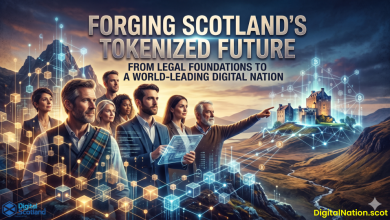
Digital Government Services: The Cornerstone of a Thriving Digital Economy
By establishing trust in online interactions, they enable secure, efficient transactions across sectors like finance, e-commerce, and public services.

 As Becca Fairless writes here the Scottish Government unveiled a refreshed National Digital Strategy in November 2025.
It is a central, foundational strategy for Scotland to achieve the goal of building a world leading digital nation.
A modern digital government provides seamless access to online services for citizens. Key technologies include Digital Identity and GovCloud Computing, and Scotland is pioneering initiatives such as ‘Digital Mailboxes’.
A Whole of Sector Approach
In November 2025, the Scottish Government and local government partners, through COSLA and the Digital Office for Scottish Local Government, took a significant step forward.
They published a refreshed Digital Strategy for Scotland alongside the Sustainable Digital Public Services Delivery Plan 2025–2028. This collaborative document reaffirms a bold, collective vision for how digital technology can enrich lives, drive economic growth, and transform public services across the nation.
The plan outlines concrete actions over the next three years, organised around six key themes: system leadership, common approaches, data, public sector capability and workforce, advanced technology and AI, and cyber resilient services.
Integrated Health, Care and Government Services
With clear responsibilities assigned between national and local government, success criteria focused on real outcomes for citizens, and a strong emphasis on joint delivery, this refresh moves beyond aspiration into actionable commitment. It responds to rapid technological change—particularly the rise of AI—while building on lessons from the original 2021 strategy and the demands of a post-pandemic world.
This moment marks more than an update to policy documents. It signals a renewed determination to place Scottish digital government services at the heart of a thriving, inclusive digital economy.
From the single secure access points like mygov.scot and ScotAccount that simplify interactions with public services, to the integration of data, common standards, and innovative technologies, Scotland is building infrastructure that is smarter, faster, and fairer—designed around people and communities rather than organisational silos.
Imagine a carer in Aberdeen seamlessly coordinating health and social care support through interconnected digital platforms that offer accessible interfaces and assisted options. Envision a small business owner in the Borders accessing grants, skills programmes, and market data without navigating fragmented systems or facing digital barriers.
Picture a young person in the Western Isles overcoming digital exclusion to gain new skills, while public resources are freed through efficient, cyber-secure, and inclusive services to invest in prevention and innovation. These are the kinds of tangible improvements the refreshed strategy and delivery plan aim to scale nationwide.
Inclusive Service Design: Leaving No One Behind
A cornerstone of the refreshed strategy is its explicit focus on inclusive access to digital and inclusive service design. Recognising that digital technology must serve as a gateway to opportunities rather than a barrier, the approach commits to designing public services that everyone can use, involving those who use them from the outset.
This means embedding digital inclusion principles throughout service development—addressing not only connectivity and devices, but also skills, confidence, motivation, and accessibility for people of all ages, abilities, incomes, and geographies.
Scotland’s framework draws on established pillars of digital inclusion: ensuring equitable access, building user confidence, providing non-digital alternatives where needed, and applying person-centred, co-design methods such as the Scottish Approach to Service Design.
Particular attention is given to groups at higher risk of exclusion—older adults, people with disabilities, low-income households, and those in rural or island communities—where infrastructure challenges can compound inequalities. By prioritising inclusive design practices, including in the adoption of advanced technologies like AI, the strategy aims to build trust, reduce exclusion, and ensure that digital transformation delivers equitable outcomes.
This commitment goes beyond accessibility standards. It involves holistic efforts: training public sector workforces in inclusive practices, engaging lived experience in service redesign, and creating seamless experiences that blend digital and offline channels. The result is services that adapt to users’ needs—whether a carer coordinating support, a small business navigating grants, or a young person in a remote area gaining essential skills—rather than forcing users to adapt to rigid systems.
Foundations for a Thriving Digital Economy
At its core, Scotland’s approach recognises that effective digital government is foundational to economic prosperity.
By fostering collaboration across government levels, investing in workforce capabilities, embracing advanced technologies responsibly, and ensuring services remain accessible and resilient through inclusive design, the strategy creates the conditions for broader success: a vibrant digital economy that attracts investment, boosts productivity, generates high-quality jobs, and supports sustainable growth in every region—from urban innovation hubs to remote rural communities.
This book examines how these digital government services and the initiatives outlined in the 2025 refresh serve as the cornerstone of that thriving digital economy. It explores the policies, platforms, and partnerships driving change; analyses successes and challenges in areas such as data sharing, AI adoption, digital inclusion, inclusive service design, and cyber resilience; and draws lessons for building public services that truly deliver for citizens while unlocking wider economic potential.
Conclusion: Action Plan Community
Whether you are a policymaker shaping the next phase of delivery, a technologist implementing solutions, a business leader navigating the opportunities, or a citizen interested in how government can harness digital for the common good, the following chapters provide an in-depth look at Scotland’s journey. The vision is clear and ambitious; the real work of making it happen—together—is now underway.
Scotland’s digital future is being shaped not just by strategy on paper, but by collaborative action on the ground. This book tells the story of how digital government services, grounded in inclusive design, are laying the foundations for a more connected, innovative, and prosperous nation.
With a focus on innovation, inclusivity, and global competitiveness, Scotland is poised to harness the power of digital transformation, setting a shining example for nations worldwide and igniting a new era of economic and societal advancement. Our community provides a forum for public and private sector innovators to meet, collaborate and realize this vision for Scotland.