The Data Hub: Scotland’s Quiet Revolution in Public Sector Data Matching and Cleansing
The Data Hub is a secure, self-service platform for public sector data matching and cleansing, enabling accurate address validation, citizen identification, and record linking, driving efficient, fraud-reducing services across local authorities.

 In an era where public services increasingly rely on accurate, joined-up data, Scotland has developed a practical, behind-the-scenes solution that is transforming how councils and other public bodies handle information.
Known simply as the Data Hub, this secure online self-service platform—delivered by the Improvement Service—has become a cornerstone tool for data matching and cleansing across Scottish public sector organisations.
Far from being a niche technical project, it is now central to the Scottish Government’s wider digital ambitions, helping to deliver smarter, more efficient, and citizen-focused services.
|
 Download the
 What Is the Data Hub and Why Was It Created?
Launched as a self-service platform in early 2018, the Data Hub originated from a very practical problem in 2016. Transport Scotland and local authorities needed to replace around one million expired National Entitlement Cards (free bus passes for older and disabled people).
The challenge? Outdated addresses and mismatched records meant many cards were being sent to the wrong people—or not at all—leading to service disruptions, public frustration, and increased administrative costs.
The Improvement Service stepped in to build a dedicated tool that could validate and cleanse large datasets quickly and securely. Today, the Data Hub is a trusted, free service for all Scottish local authorities and partner public sector organisations. It is built on the same secure infrastructure as the widely used mygovscot myaccount system, ensuring high standards of data protection and accessibility.
How the Data Hub Works: Simple, Powerful Tools for Complex Tasks
At its heart, the Data Hub offers a suite of specialised programs that automate what used to be labour-intensive manual processes:
- Address Matching Program: The most popular feature. It cross-references submitted address lists against the authoritative One Scotland Gazetteer (OSG) dataset. Users receive categorised results (match, no match, new match needed) and can resolve ambiguities using an integrated interactive map and address search tool. Outputs are downloadable in convenient templates.
- Unique Citizen Reference Number (UCRN) Seeding Program: Available to local authorities, this adds or verifies the unique citizen identifier used across Scottish public services. It can also flag dates of death—vital for benefits audits and fraud prevention.
- Additional programs support seeding missing data, matching records across multiple sources, and generating summary/analysis reports.
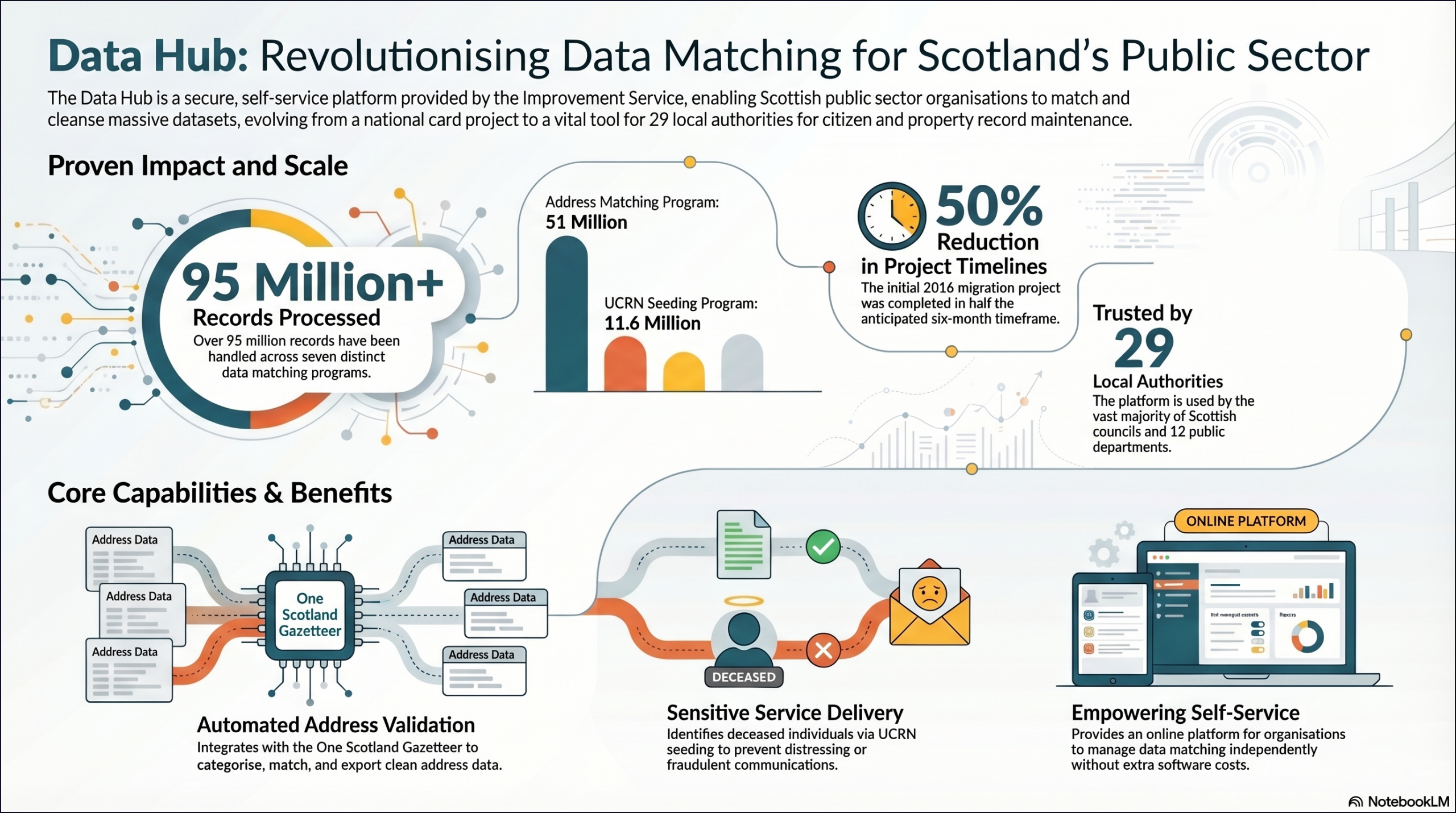
The platform is deliberately user-friendly. Users upload their data, start a process, and receive email notifications when results are ready—allowing them to continue other work rather than babysit lengthy batch jobs. It handles massive volumes: one organisation alone processed 27.8 million records in a single run. Overall, the Data Hub has now processed over 95 million records across seven distinct programs, with the Address Matching tool accounting for more than 51 million.
Real-World Impact: Faster Services, Less Waste, Better Outcomes
The benefits are concrete and measurable. Public sector bodies report:
- Dramatic time and cost savings: A project that once took six months can now be completed in three.
- Improved service accuracy: Correct addresses prevent cards, letters, or benefits from going astray. Accurate citizen data supports everything from vaccination cohort identification to energy efficiency programmes.
- Fraud reduction and better governance: Flagging deceased individuals helps stop payments to non-existent claimants.
- Strategic value: Organisations use the cleansed data for master data management, customer analytics, and long-term planning.
Testimonials highlight its practicality. Victor Chamosa Pino, Data Management Officer at the Energy Savings Trust, praised the address matching tool’s speed and accuracy, noting the “invaluable” map and search function that turns tedious manual work into a simple process. He added that the team would continue using it “in our work supporting Scottish Government.”
Ciara Gribben, Senior Information Analyst at Public Health Scotland, described the Data Hub as “a valuable resource” for the Scottish Vaccination and Immunisation Programme. The email notifications mean staff can set processes running and move on to other tasks, while the improved accuracy of vaccination cohorts directly supports public health surveillance.
Twenty-nine of Scotland’s 32 local authorities, plus nine other public sector organisations, now rely on it regularly.
Why the Data Hub Is Central to Scotland’s Digital Ambitions
The Scottish Government’s refreshed Digital Strategy for Scotland (November 2025) and the accompanying Sustainable Digital Public Services Delivery Plan 2025–2028 set out an ambitious vision: digital innovation that makes public services “smarter, faster, and fairer,” with quality data at the centre.
Key priorities in the strategy include:
- Improving data quality and sharing across the public sector.
- Developing common platforms and reusable solutions to avoid duplication and reduce costs.
- Ethical, secure use of data to support prevention, early intervention, and better citizen outcomes.
- Collaborative working between national and local government.
The Data Hub directly embodies these goals. It is explicitly positioned by the Improvement Service as one of the core “common platforms” available to the entire Scottish public sector. By standardising data using trusted identifiers—such as Unique Property Reference Numbers (UPRNs), UCRNs, and Community Health Index (CHI) numbers—it acts as “the missing link” that joins up housing, health, social care, and other services.
This aligns perfectly with the strategy’s emphasis on a “data-driven” approach to public services. Rather than every council or agency building its own expensive data-matching systems, the Data Hub provides a shared, maintained national resource—free at the point of use. It reduces fragmentation, speeds up digital transformation, and frees up resources for frontline services.
The Improvement Service’s own Data and Intelligence Strategy 2023–2027 explicitly commits to further developing the Data Hub as part of creating a single, coherent data platform for Scottish local government.
In short, the Data Hub is not a standalone tool—it is infrastructure for the Government’s broader ambition of a “digitally connected country” where high-quality data powers efficient, personalised, and preventive public services.
Looking Ahead
The Improvement Service continues to expand the Data Hub’s reach and functionality, seeking new use cases and welcoming more partners. As Scotland rolls out initiatives such as a single public services app (planned for 2026), shared digital planning systems, and greater use of AI, clean and reliable data will be the essential foundation. The Data Hub is already providing that foundation.
By quietly solving one of the public sector’s most persistent headaches—messy, mismatched data—it is enabling the bigger digital vision: services that work better for people, cost less to run, and deliver measurable improvements in Scottish lives. In the complex world of government technology, sometimes the most valuable innovations are the ones that simply make the basics work reliably. The Data Hub is doing exactly that.