Digital Scotland Proposes AI Strategy to Transform Scottish Health and Social Security
New Blueprint Proposes an Exemplar of 'AI for Social Good', an AI-Powered Ecosystem to Tackle Scotland’s Interlocking Health and Poverty Crises.

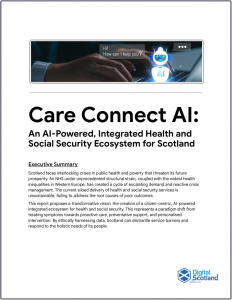 A landmark strategy report released today proposes a radical redesign of Scotland’s public services, calling for the creation of an AI-powered, integrated ecosystem for health and social security under a banner of ‘Care Connect AI’.
The report, “Harnessing AI to Build an Integrated Health and Social Security Ecosystem for Scotland,” argues that this transformative approach is essential to break the vicious cycle of poor health and poverty that is placing unsustainable pressure on the NHS and society.
The strategy outlines how the latest AI technologies can enable a shift from the current model of reactive crisis management towards a proactive system of preventative care and personalised support.
By securely and ethically harnessing data from across NHS Scotland, Social Security Scotland, and local government, the proposed ecosystem aims to identify and support at-risk individuals and communities before their health or financial situations deteriorate.
The report presents a stark analysis of the interlocking crises facing the nation. NHS Scotland is under unprecedented and structural strain, a situation that was worsening for years before being exacerbated by the pandemic, and furthermore this health divide is inextricably linked to poverty. In-work poverty has become the norm, with six in ten people in poverty living in a household where someone works, and over 50,000 are homeless.
‘No Wrong Door Chatbots’
The central design goal of this solution is a “No Wrong Door Chatbot”, referring to an AI-powered conversational system designed to connect users with the appropriate support services regardless of where they initially access the system.
“No Wrong Door” programs are initiatives designed to ensure that individuals, particularly those seeking services like mental health, substance abuse treatment, or social support, can access help regardless of which agency or entry point they contact. It means they can “knock on any door” and still receive the right assistance without being directed to the wrong agency or department; essentially acting as a single point of entry for diverse needs, eliminating the need to navigate complex systems to find the proper help.
The Care Connect AI blueprint is more than a technological proposal; it is a fundamental redesign of the relationship between citizens and the services meant to support them.
It offers a pathway to move from a system defined by confusion and duplication to one characterized by clarity, coordination, and compassion. By intelligently and ethically connecting data, we can build a future where technology empowers a more humane, proactive, and dignified model of care for everyone.
AI for Social Good
The promise of “AI for Social Good” is one of the most compelling narratives of our technological age: the idea that artificial intelligence can be harnessed not just for commercial gain, but to tackle society’s most complex and persistent challenges. It envisions a future where technology serves humanity, enhancing our capacity for compassion, improving wellbeing, and promoting a fairer society.
The Care Connect AI ecosystem is a powerful, practical embodiment of this vision—a blueprint for how AI can be ethically implemented to deliver tangible social benefits.
Scotland has laid out a bold and ambitious roadmap for its future: to become a world-leading digital nation, built on a foundation of trustworthy, ethical, and inclusive Artificial Intelligence. This vision, detailed in the nation’s AI Strategy, is not merely about technological advancement but about harnessing AI to achieve national outcomes, improve the lives of its citizens, and create a fairer, greener, and more prosperous society.
While strategies provide the map, it is pioneering projects that chart the course. The Care Connect AI initiative stands as a powerful exemplar of this national ambition in action. More than just a single project, it is a cornerstone of the AI roadmap, demonstrating how a people-centric approach to technology can transform essential public services and deliver on the promise of a truly ethical digital nation.