Pioneering the Metaverse in Scottish Schools: Immersive Learning for Children
Scottish schools can harness Metaverse virtual worlds—persistent, immersive 3D environments, to pioneer experiential, scalable, and personalized learning models that transcend the limitations of flat video or 2D screens.

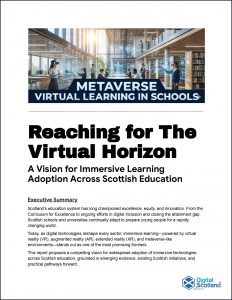 The metaverse—persistent, shared virtual worlds accessed via VR/AR headsets, computers, or mobile devices—is emerging as a transformative tool for digital education.
By creating immersive 3D environments, it moves learning beyond passive screens and textbooks into experiential, interactive spaces tailored for young learners.
Schools can harness Metaverse virtual worlds—persistent, immersive 3D environments such as Roblox, Decentraland, Spatial, or custom platforms built with Unity or Unreal—to pioneer experiential, scalable, and personalized learning models that transcend the limitations of flat video or 2D screens.
Core Educational Applications
One powerful approach involves historical and scientific simulations, where students step into meticulously recreated 3D environments. They might walk the streets of Ancient Rome in 44 BCE, witnessing Caesar’s assassination from the perspectives of a senator, plebeian, or guard, or shrink to a nanoscale view inside a cell to observe DNA replication in real time.
- Virtual Field Trips and Simulations: Students “visit” ancient Rome, dissect virtual frogs, or explore the human body at cellular scale without leaving the classroom. Platforms like Minecraft Education Edition or Roblox Studio enable history recreations, physics experiments, and ecosystem modeling.
- Collaborative Project-Based Learning: Avatars allow global peer collaboration on shared builds (e.g., designing sustainable cities) or role-playing scenarios (debating as historical figures), fostering social skills and creativity.
- Personalized and Inclusive Pathways: AI-driven avatars adapt content to individual pace and learning styles; VR supports special needs, such as sign-language interpreters or sensory-adjusted environments for neurodiverse students.
These experiences rely on photogrammetry scans, like those used in Rome Reborn, combined with physics engines and AI-driven NPCs powered by GPT-like models to facilitate Socratic questioning.
Key Benefits
Metaverse-based learning innovations enable experiential mastery by letting students learn through risk-free, immersive simulations—like triggering chemical explosions or governing virtual societies—yielding recall rates three times higher than textbooks.
They foster global collaboration at scale, with cross-border teams co-creating in persistent worlds, building cultural competence and real-world teamwork skills.These models deliver personalization and inclusion, using AI to adapt difficulty in real time and sensory controls to support neurodivergent learners, ensuring equitable engagement.
They provide cost-effective access to otherwise impossible experiences, from particle colliders to surgical theaters, democratizing advanced STEM and vocational training without physical risk or expense.
- Engagement and Retention: Studies (e.g., PwC 2021) show VR learners are 4× more focused and retain 75% more information than traditional methods.
- Safe Exploration: Children experiment with high-risk concepts (chemical reactions, space travel) in fail-safe digital sandboxes.
- Equity Potential: Cloud-based access lowers hardware barriers over time, though initial costs remain a hurdle.
By 2030, analysts (McKinsey, Gartner) predict 25% of classrooms will incorporate metaverse elements, driven by falling VR costs and 5G/6G rollout. Success hinges on teacher professional development, evidence-based curricula, and ethical data policies. When implemented thoughtfully, the metaverse shifts education from “learning about” to “learning within,” preparing children for a digitally native future.
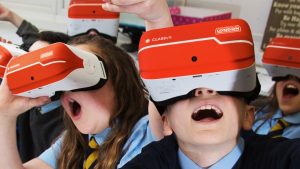 Scottish Pioneers
As The Times reported Scotland boasts a keynote case study about one of the Scottish schools at the forefront of this trend: Erskine Stewart’s Melville Schools, exploring how the school integrates technology to foster innovative, inclusive education.
Championed by visionary Mr Simon Luxford-Moore, recognised as one of the TES Edtech 50 leaders in 2020, Simon has an inspiring passion for Scotland realising its ambition to become a world leading digital nation.
This modernized education is central to that goal, as it is equipping the young people with the skills they need for the 21st century economy in which we now participate. Students may be competing with peers from India for jobs that are entirely remote, and he has to be preparing them for jobs that don’t even exist yet.
Digital Inclusion
Mr Luxford-Moore explained how this adds a new category of learning modes. There is visual, auditory and kinaesthetic, and Simon defines ‘Experiential’ as a fourth, with quite profound implications and benefits for teaching.
The goal is to prepare students for a global digital economy by emphasizing self-discovery, critical thinking, collaboration, and experiential learning over traditional rote methods, aligning with Scotland’s vision to become a world-leading digital nation.
He is passionate about inclusive learning, where if you design teaching to accommodate a neuro-diverse audience the minority of whom may have the most difficulties, from physical to mental challenges, it will be all encompassing, beneficial to all the students. VR offers a mode of engagement that addresses these challenges and removes barriers to learning in a way that traditional media cannot.
Luxford-Moore stresses that technology supports—not replaces—learning, valuing the “journey of investigation” over single correct answers. Outcomes include enhanced skills for competitiveness (e.g., against peers in India) and a shift toward education as a collaborative “resource pool” for all Scottish schools.
Sharing and Scaling Best Practices
He envisions a revolutionized Scottish education system harnessing VR and digital creation to level opportunities, foster innovation, and position the nation as a digital powerhouse. By empowering students as creators, ESMS’s model could inspire widespread adoption, preparing a generation for an immersive, interconnected world.
The challenge for Scotland is how are these pioneering projects replicated wholesale across Scotland. There are other individual projects, like ‘Museums in the Metaverse‘, which are also breaking new ground, and so the key question critical to our success is how are these innovations shared across the entire nation.
Scotland’s ambition to be a world-leading digital nation lies in harnessing these trends to transform our Education system, where schoolchildren are empowered to create learning content shared with other students, using the tools and technologies central to the future of the 21st century.
Critically it breaks down the barriers between public and private schools, creating a single playing field where investments and learning by one school is contributed to a shared pool from which all can benefit.