Empowering Scotland’s Future: How AI Can Transform Schools and Fuel a Thriving Digital Economy
The pupils in our classrooms are not just learning about AI; they are preparing to shape it, and through it, to shape Scotland’s success for generations to come.

 Scotland stands at a pivotal moment.
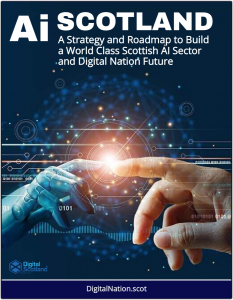
With the launch of Scotland’s AI Strategy 2026–2031 and the refreshed Digital Strategy for Scotland 2025, the nation has set an ambitious course to become a leader in trustworthy, ethical, and inclusive AI.
At the heart of this vision lies education. By smarter integration of AI into teaching practices and a deliberate embedding of AI literacy across the curriculum, Scottish schools can not only enhance learning outcomes today but also produce graduates ready to drive the digital economy of tomorrow.
AI as a Powerful Ally in the Classroom
The Scottish Government’s Guidelines and Guardrails for the Use of Artificial Intelligence (AI) in Schools, published in March 2026 in partnership with the Educational Institute of Scotland (EIS), provide a clear framework for responsible adoption. These guidelines stress that AI must remain a tool that supports—not replaces—teacher judgement, while prioritising children’s rights, safety, privacy, and ethical standards.
Personalised learning at scale is perhaps the most immediate benefit. AI-powered platforms can analyse individual pupil progress in real time, adapting content difficulty, pace, and style to suit diverse needs. A pupil struggling with fractions might receive visual explanations and extra practice; a high-achiever could be challenged with extension tasks involving real-world applications.
Early pilots and resources from projects like TRAILS (Teaching Responsible AI Literacy in Schools) at the University of Edinburgh already demonstrate how AI can generate differentiated worksheets, creative writing prompts, or targeted feedback far faster than any single teacher could manage alone.
Teachers gain precious time through AI-assisted administration. Tools that draft lesson plans, mark routine assignments (with human oversight), or summarise pupil data free educators to focus on relationships, creativity, and high-value interventions—the very things that define excellent Scottish teaching under Curriculum for Excellence. Inclusive education also benefits: AI can translate materials, provide speech-to-text for neurodiverse learners, or simulate accessible environments for pupils with additional support needs.
Crucially, the new Digital Education and AI Hub (launched in 2026 as part of the Centre for Teaching Excellence) equips teachers with research-informed professional learning. Sessions on “AI and Creativity,” “Using AI Responsibly,” and inclusive digital tools ensure staff feel confident rather than overwhelmed.
The guardrails are equally important: AI must never make high-stakes decisions about pupils or staff, and schools are encouraged to maintain human connection at the core of learning. Used well, AI becomes an invisible scaffold that lifts every child higher.
Building AI Literacy into the Curriculum: From Awareness to Mastery
Scotland’s Curriculum Improvement Cycle already signals that learning about and with AI will become more prominent. The opportunity now is to move from ad-hoc use to structured, progressive AI literacy that prepares every young person for an AI-infused world.
Age-appropriate integration is key. In primary schools (P5–P7), resources such as the Children’s Rights & AI Teaching Pack (developed by Children’s Parliament, the Scottish AI Alliance, and the Alan Turing Institute) introduce concepts through stories and discussions about fairness, bias, and rights. Pupils explore simple recommender systems or image generators while reflecting on how AI affects their daily lives.
At secondary level, the TRAILS Teach AI Literacy Handbook offers a world-first curriculum framework centred on children’s rights and ethics. It includes practical modules on how AI works (machine learning basics without requiring advanced coding), responsible prompting, detecting bias, and collaborative human-AI projects. These can slot into existing subjects—Computing Science for technical depth, Social Studies for ethical debates, or Expressive Arts for AI-generated creativity.
Cross-curricular approaches amplify impact. A biology class might use AI to model climate scenarios; an English class could debate AI authorship. By S4–S6, pupils could undertake capstone projects: designing ethical AI solutions for local challenges, such as sustainable transport or community health apps. Assessment would reward critical thinking and collaboration alongside technical skill.
Teacher training via the Digital Education and AI Hub, combined with open-access resources from TRAILS and the Scottish AI Alliance, removes barriers to implementation. Local authorities can pilot these approaches, sharing best practice through Glow and the new hub’s professional learning community.
The outcome? Graduates who are not merely AI users but confident, ethical creators and critics—precisely the profile global employers and Scotland’s tech sector demand.
Linking Education Reform to a Bold Digital Economy Strategy
This is not an isolated education project; it is a strategic economic imperative. Scotland’s AI Strategy 2026–2031 explicitly names “workforce skills” and “prepared young people” as priorities.
It commits to AI literacy for all, a Future Jobs Panel to map AI’s workforce impact, and modular training that equips citizens to thrive. The strategy aims to close the productivity gap, drive innovation, and secure billions in economic value by harnessing AI across public services, business, and research.
The Digital Strategy for Scotland 2025 reinforces this vision: digital technologies must “connect people to opportunities, create economic growth, and deliver improved public services.” A thriving digital economy—built on strengths in AI, data science, and ethical innovation—depends on a pipeline of home-grown talent. By producing AI-literate graduates, schools directly support ambitions to attract inward investment, expand digital exports, and ensure SMEs across sectors (from renewables to creative industries) can adopt AI confidently.
Equity is baked in. Universal access to AI literacy prevents a two-tier system where only privileged pupils benefit. Inclusive, rights-based education aligns with Scotland’s values of fairness and opportunity for all, ensuring no region or demographic is left behind in the digital transition.
Investment in infrastructure—devices, high-speed connectivity, and secure AI tools—alongside the ethical guardrails already published, will create a coherent national approach. The result: a virtuous cycle where better-educated young people fuel economic growth, which in turn funds further innovation in schools.
A Call to Action for Scotland’s Schools
The foundations are laid. National strategies, guidelines, teacher hubs, and free resources like TRAILS provide the roadmap. What remains is bold, coordinated implementation: local authorities embedding AI literacy in school improvement plans, headteachers championing ethical innovation, and government sustaining investment in the Digital Education and AI Hub.
Scotland has the chance to lead not just in AI adoption but in responsible AI education. By transforming how we teach and what our young people learn, we can secure a future where technology serves humanity—delivering better learning today and a more prosperous, inclusive digital economy tomorrow.
The pupils in our classrooms are not just learning about AI; they are preparing to shape it, and through it, to shape Scotland’s success for generations to come.