Empowering Change: Simon Community Scotland’s Potential Role in the Care Connect AI Ecosystem
Scotland's fight against homelessness could be transformed by AI. Discover how Simon Community Scotland's 60+ years of frontline expertise + digital innovation could power the Care Connect AI ecosystem for more compassionate, effective support.

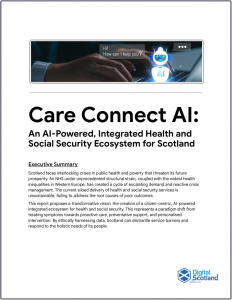 In the evolving landscape of Scotland’s social care, the Care Connect AI blueprint stands as a visionary framework for integrating artificial intelligence into a unified, “No Wrong Door” platform.
By connecting third-sector organizations with government agencies through a conversational AI interface, it promises instantaneous, personalized support for vulnerable individuals—ranging from health advice to crisis intervention.
Scotland’s Homelessness Crisis
Scotland’s homelessness situation remains a pressing national crisis in 2026, despite some modest reductions in new applications and ongoing government efforts to address the housing emergency.
According to the latest Scottish Government statistics for April to September 2025 (the most recent detailed period available), there were 20,643 applications for homelessness assistance—a 2% decrease from the previous year—while 17,291 households were assessed as homeless or threatened with homelessness, also down 2%.
However, the overall pressure on the system has intensified: open homelessness cases reached a record high of 33,006 by 30 September 2025 (up 4% year-on-year), and the number of households in temporary accommodation stood at 18,092 (a 9% increase), the highest since records began.
Alarmingly, this included 10,480 children living in temporary accommodation—the highest level on record and a stark indicator of the crisis’s impact on families. Rough sleeping reports have also risen significantly over recent years, with the Scottish Government declaring a housing emergency and committing substantial investments in affordable homes.
Tragically, an estimated 231 people died while experiencing homelessness in 2024 (the latest full-year data), equivalent to roughly four deaths per week, with higher rates in urban areas like Edinburgh and Glasgow.
These figures highlight deep-rooted issues including poverty, lack of affordable housing, mental health challenges, and intersecting vulnerabilities, underscoring the urgent need for integrated support systems to prevent and resolve homelessness across the country.
Simon Community Scotland: A Pillar in Homelessness Support
As Scotland grapples with interconnected challenges like homelessness, mental health, and social isolation, organizations like Simon Community Scotland (SCS) emerge as pivotal partners.
With over 60 years of frontline experience in combating homelessness, SCS could infuse the ecosystem with grassroots expertise, digital innovation, and a human-centered approach, enhancing the platform’s ability to address complex needs holistically.
Founded in 1963 as part of the broader Simon Community network, SCS has grown into one of Scotland’s leading charities dedicated to preventing and resolving homelessness. Operating primarily in Glasgow, Edinburgh, North Lanarkshire, and Perth and Kinross, the organization supports over 3,000 people annually, many facing complex issues such as addiction, mental health challenges, and poverty.
Their mission is clear: to provide information, advice, care, support, accommodation, and homes, emphasizing that “everyone deserves a safe place to live and the support they need.”
SCS’s services span street outreach, emergency accommodation, 24/7 helplines (e.g., Glasgow: 0800 027 7466; Edinburgh: 0808 178 2323), and transitional housing. Recent initiatives, such as the “Bridges to Belongings” project launched in 2024, focus on community-informed priorities for transitioning from homelessness to inclusion, highlighting the charity’s commitment to prevention and long-term recovery.
By 2026, SCS continues to address Scotland’s housing emergency, where over 30,000 people are homeless and demand for services is at an all-time high.
Tackling Interlinked Challenges: Homelessness, Loneliness, and Beyond
Homelessness in Scotland is not an isolated issue; it often intersects with loneliness, mental health deterioration, and substance misuse, amplifying the need for integrated care solutions. SCS recognizes this, offering holistic support that includes befriending services and community-building efforts to combat isolation.
For instance, their work extends to related harms like gambling addiction, which can exacerbate financial instability and homelessness. In a nation where nearly half of older adults experience loneliness and disabled individuals face heightened risks, SCS’s interventions could align seamlessly with Care Connect AI’s Loneliness Companions feature, which provides empathetic AI-driven check-ins and referrals.
The charity’s emphasis on meeting people “where they are” resonates with the AI platform’s goal of non-judgmental, accessible support. By addressing root causes like poverty and inequality, SCS helps break cycles of exclusion, making them an ideal collaborator for an ecosystem aiming to reduce healthcare burdens through preventative care.
Digital Innovation at SCS: A Foundation for AI Integration
SCS has demonstrated a forward-thinking approach to technology, positioning them well for involvement in digital care ecosystems.
Their Digital Inclusion Programme, active since 2017, has supported nearly 3,000 people by providing refurbished tech and free connectivity, bridging the digital divide for those experiencing homelessness. A 2026 blog post by their Digital Inclusion Programme Manager underscores that “digital inclusion depends on people, not tech,” advocating for culture-first strategies in technology adoption.
A standout example is Aila, SCS’s award-winning digital platform for women experiencing gambling harm. Launched as a co-designed website, Aila offers resources, real-life stories, live chat support, and community spaces to raise awareness, reduce stigma, and signpost services.
In 2026, Aila secured the Digital Service Transformation Award at the Holyrood Connect Digital Health and Care Awards, recognizing its gendered, proactive response to gambling harms that often intersect with homelessness. While not explicitly AI-driven, Aila’s interactive features, such as live chats and personalized signposting, mirror elements of conversational AI, showcasing SCS’s capability in digital service delivery.
Additionally, SCS has piloted sensor technology to reduce drug deaths among homeless individuals, demonstrating an openness to innovative tools for harm reduction. This aligns with broader Scottish initiatives, like the government’s AI Policy Framework and SCVO’s Digital Call to Action, which encourage third-sector adoption of AI ethically and strategically.
Envisioning SCS’s Role in Care Connect AI
Within the Care Connect AI ecosystem, SCS could play a multifaceted role, leveraging their expertise to enhance the platform’s federated knowledge base and central data hub.
As a third-sector specialist in homelessness, they might contribute specialized content for the AI chatbot, enabling users to access instant advice on housing emergencies, helpline referrals, or eligibility for support services. For example, integrating SCS’s 24/7 helplines into the conversational interface could provide seamless transitions from AI-guided queries to human support, ensuring no one falls through the cracks.
SCS could also co-design features tailored to vulnerable groups, such as AI-driven loneliness companions adapted for those in temporary accommodation, incorporating insights from their befriending and outreach programs. Their Digital Inclusion Programme could inform ethical AI deployment, emphasizing accessibility for digitally excluded populations—vital in rural or low-income areas.
Furthermore, by sharing anonymized data on homelessness trends, SCS could help refine the platform’s predictive capabilities, flagging at-risk individuals for early intervention.
In partnerships, SCS’s collaborations—such as with local authorities and other charities—could extend to government agencies within the ecosystem, like Health and Social Care Partnerships (HSCPs), to create a unified response to overlapping issues like mental health and addiction. Drawing from Aila’s success, SCS might pilot AI-enhanced tools for gambling harm prevention, integrating them into Care Connect’s broader support network.
A Collaborative Path Forward
As Scotland advances toward a digitally empowered care system, Simon Community Scotland’s inclusion in the Care Connect AI ecosystem could transform how homelessness and related vulnerabilities are addressed. By blending their compassionate, people-first ethos with AI’s scalability, the platform stands to deliver more equitable, efficient support—ultimately fostering a society where no one is left behind.
With ongoing digital health strategies and awards recognizing innovations like Aila, SCS is primed to contribute meaningfully, turning the blueprint into a beacon of hope for Scotland’s most marginalized communities.