A Global Expansion Strategy for Scotland’s Quantum Computing Sector
Scotland aims to drive economic growth by leveraging its quantum computing expertise to become a trusted global provider of secure sovereign quantum and AI solutions.

 Scotland possesses a concentrated cluster of world-class quantum expertise, particularly in hardware platforms (neutral atoms, superconducting qubits), quantum software, simulation, and photonics-enabled technologies.
With over 30 active quantum companies, strong university hubs (Edinburgh, Glasgow, Strathclyde, Heriot-Watt), and recent government investments like £8.9 million for quantum leadership, Scotland is positioned to capture significant value in the global quantum economy.
The global quantum computing market, currently valued in the low billions, is projected to grow rapidly to $4–20 billion by 2030 (CAGRs ranging 20–40%+ depending on the source), with broader economic impact potentially reaching hundreds of billions to $1 trillion by the mid-2030s.
Sovereign AI
The strongest near-to-medium-term opportunity lies at the intersection with Sovereign AI—the drive by nations to secure domestic control over advanced compute, data, and AI infrastructure for strategic autonomy, national security, and economic competitiveness.
Scotland can differentiate through sovereign-capable, secure, and hybrid quantum-AI solutions, leveraging its European/UK base, renewable energy advantages, and trusted research ecosystem.
I. Global Market Opportunity for Quantum Computing
Quantum computing leverages superposition, entanglement, and interference to solve certain problems intractable for classical computers, excelling in optimization, simulation, machine learning, and cryptography. While full fault-tolerant systems remain years away, hybrid quantum-classical approaches and quantum-inspired algorithms are already delivering value in proofs-of-concept and early deployments.
Market Projections (as of 2025–2026 data):
- 2024/2025 baseline: ~USD 1.4–3.5 billion.
- 2030 forecasts: USD 4–20 billion, with CAGRs of 20–42%.
- Longer term: Hardware/software market potentially $10B+ by 2045; economic value creation $450–850 billion by 2040.
Key Drivers:
- AI and High-Performance Computing (HPC) Convergence: Quantum accelerates training/inference for complex models and enables quantum machine learning (QML).
- Industry Applications: Drug discovery/molecular simulation (pharma), portfolio optimization/risk modeling (finance), logistics/supply chain, materials science, and cryptography (post-quantum migration).
- Government and Defense Investment: National security imperatives around encryption-breaking threats and secure communications.
- Cloud Delivery (QCaaS): Lowers barriers; expected to represent a large share of early revenue.
Sovereign AI as the Premier Megatrend: Nations increasingly view advanced compute as critical infrastructure, akin to energy or defense. Governments (UK, EU, US, Canada, India, Gulf states, etc.) are investing billions to avoid dependency on foreign hyperscalers, secure sensitive data, and build domestic talent/supply chains. Quantum enhances this by offering exponential advantages in simulation, optimization, and secure networking (e.g., quantum key distribution). Hybrid quantum-AI systems for sovereign clouds, defense modeling, and critical infrastructure simulation represent a high-priority, well-funded intersection.
The UK is actively pushing tech sovereignty with multi-billion commitments to AI, quantum, and supercomputing, including procurement and a Sovereign AI Fund. Scotland’s renewable-powered data center initiatives (e.g., Cowal Peninsula) align perfectly with green sovereign infrastructure goals.
Challenges include technical immaturity (error rates, scalability), talent shortages, and high costs, but these create openings for specialized players offering secure, application-specific solutions rather than competing directly with US giants like IBM, Google, or IonQ on raw scale.
II. Tactical Sales Plan for Scotland’s Quantum Sector
Scotland should position itself as a trusted European partner for Sovereign Quantum-AI solutions—emphasizing security, supply-chain resilience, academic rigor, and integration with green compute. Focus on B2G/B2B enterprise sales with hybrid offerings (quantum simulators, specialized QPUs, software tools, and consulting) rather than pure hardware scale.
Primary Niche Segments to Target (Prioritized by Sovereign AI Intersection)
- Sovereign AI / Government & Defense (Core Focus – 40–50% of near-term effort):
- Why? High budgets, strategic urgency, alignment with UK/EU policies. Quantum for secure AI training, simulation of complex systems (e.g., climate, energy grids, defense scenarios), and post-quantum cryptography.
- Sub-targets: UK/EU governments, NATO allies, defense primes (secure modeling, optimization for logistics/sensor fusion), national AI initiatives in Canada, India, Gulf states seeking diversified suppliers.
- Scotland’s Edge: Quantum networks, simulation expertise (e.g., neutral atoms at Strathclyde), niobium-based hardware components for sovereign supply chains (e.g., Quantcore).
- Pharma & Healthcare (20–25%):
- Quantum simulation for drug discovery, molecular dynamics, and hybrid QML for personalized medicine. Sovereign data privacy concerns favor trusted non-US providers for sensitive health data.
- Finance & Optimization (15–20%):
- Portfolio optimization, risk analysis, fraud. Target European banks and sovereign wealth funds seeking compliant, localized solutions.
- Energy & Climate (Cross-cutting):
- Materials for renewables, grid optimization. Leverage Scotland’s green energy for carbon-negative quantum-AI offerings.
Route-to-Market Channel Plans
Phase 1: Build Momentum (0–12 months) – Domestic & UK Foundation
- Leverage UK Sovereign AI/Quantum funding and procurement (£1B+ quantum commitments). Partner with UKRI, Innovate UK, and Scottish Enterprise.
- Expand QCaaS via cloud partnerships (e.g., integrate with existing UK sovereign cloud initiatives).
- Pilot programs with Scottish/UK defense, NHS, and financial institutions.
Phase 2: European & Allied Expansion (12–36 months)
- Channel Partners: System integrators (e.g., Thales, Leonardo—already active in Scotland’s photonics/quantum ecosystem), hyperscalers for hybrid offerings, and consulting firms (Deloitte, BCG) for enterprise entry.
- Government-to-Government: Trade missions via SDI (Scottish Development International), align with EU Quantum Flagship or bilateral deals. Offer “Quantum-as-a-Sovereign-Service” bundles.
- Academia-Industry Consortia: Use QCA Cluster (Strathclyde, Edinburgh, Glasgow) for joint R&D leading to commercial pilots.
Phase 3: Global Scale (24+ months)
- Target “middle powers” (Canada, Australia, India, Gulf) wary of US/China dominance. Position via sovereign supply chain assurances and talent exchange programs.
- Sales Model: Mix of direct sales for strategic accounts, channel partners for volume, and licensing/IP for software/tools.
- Marketing: Highlight “Trusted Scottish Quantum” — rigorous standards, photonic/hybrid strengths, renewable integration. Attend key events (e.g., Quantum Business Conference, defense expos) with demos of Sovereign AI use cases.
- Partnerships: Co-develop with global players (e.g., Rigetti ties already exist) while maintaining IP control. Invest in talent visas and training to scale teams.
Tactical Execution Elements:
- Pricing: Hybrid (subscription QCaaS + project-based consulting + hardware components). Emphasize TCO savings via early hybrid value.
- Go-to-Market Assets: Case studies on quantum simulation for AI, white papers on Sovereign Quantum-AI governance, security certifications (e.g., alignment with UK NCSC).
- Metrics for Success: Secure 5–10 flagship sovereign pilots in Year 1–2; target 20–30% YoY revenue growth; build pipeline of £100M+ in export opportunities by 2030.
- Risk Mitigation: Address talent gaps via university pipelines; invest in error-corrected/hybrid tech roadmaps; monitor geopolitics for export controls.
Conclusion and Recommendations
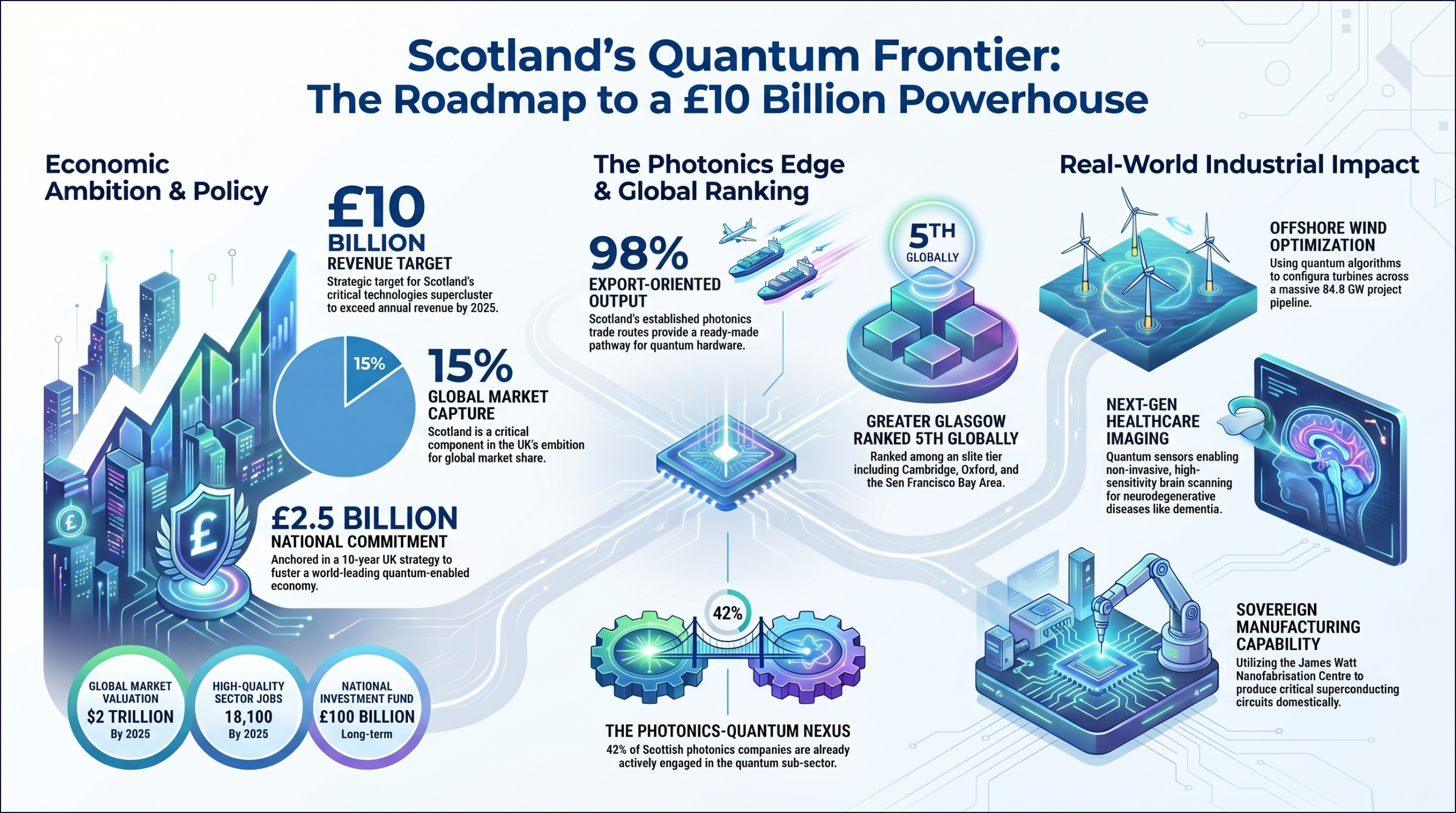
Scotland’s quantum sector can drive substantial economic growth—potentially contributing to the Critical Technologies Supercluster’s £10 billion revenue ambition by 2035—by riding the Sovereign AI wave. Success requires coordinated action: sustained public-private investment, aggressive international promotion of sovereign credentials, and rapid commercialization of hybrid quantum-AI applications.
Key next steps: Establish a dedicated “Scotland Sovereign Quantum-AI Taskforce” uniting industry, academia, and government; launch targeted trade missions to key sovereign AI markets; and prioritize scalable software/simulator offerings that deliver value today while building toward tomorrow’s hardware leadership.
With focused execution, Scotland can evolve from a research powerhouse to a global exporter of strategic quantum capabilities.